
The difficult work starts after the number appears
A report says same-store sales are down.
That is useful. It is also where the real analysis begins.
Did customers visit less often, or spend less per transaction? Is the decline isolated to one location or visible across the region? Is the comparison fair, or are we measuring against an unusual prior period?
The dashboard has shown what happened. Now the analyst has to work toward an explanation.
That usually means moving between reports, filtering stores, checking prior periods, comparing benchmarks, and keeping track of which observations are supported facts and which are still hypotheses. The challenge is building an explanation that can withstand the next question.
One result creates a chain of questions
An analyst looking at a sales decline rarely stops at the headline number. The natural questions follow:
- Is the decline coming from fewer transactions, lower spending per transaction, or both?
- How does this store compare with relevant peers?
- Is the comparison period representative?
- What additional evidence would help explain the change?
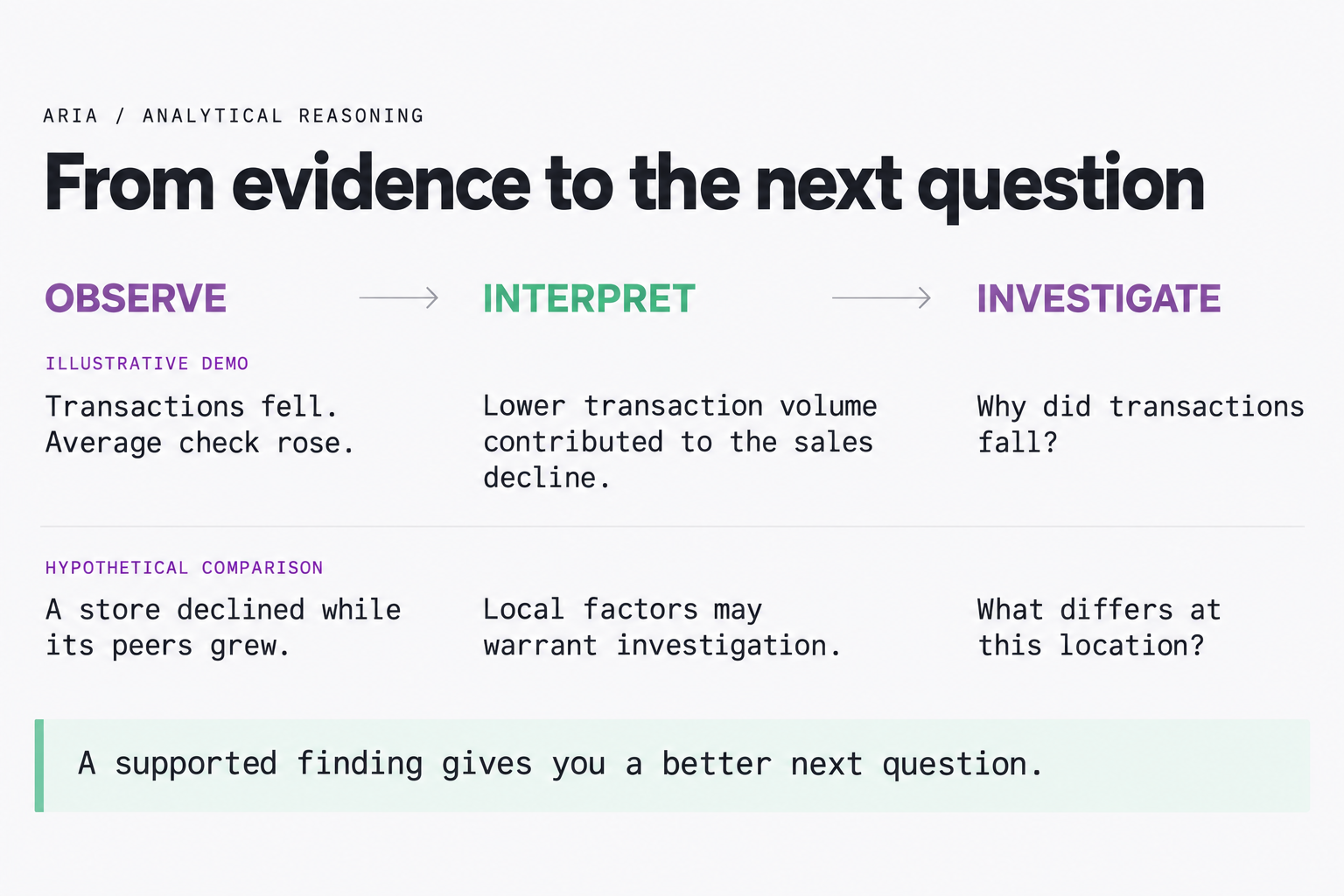
Each answer shapes the next question. A store declining alongside its peers calls for a different investigation from a store declining while its peers grow. A drop in transactions raises different questions from a drop in average check.
ARIA brings that conversation into the report itself. An analyst can ask questions alongside the result they are examining, then use the answers to guide the investigation.
From a sales decline to a more useful explanation
In the illustrative example below, same-store sales are down. ARIA’s response examines the relationship between sales, transactions, and average check.
The finding is more useful than the headline alone: transactions declined while average check increased, helping offset some of the sales loss.
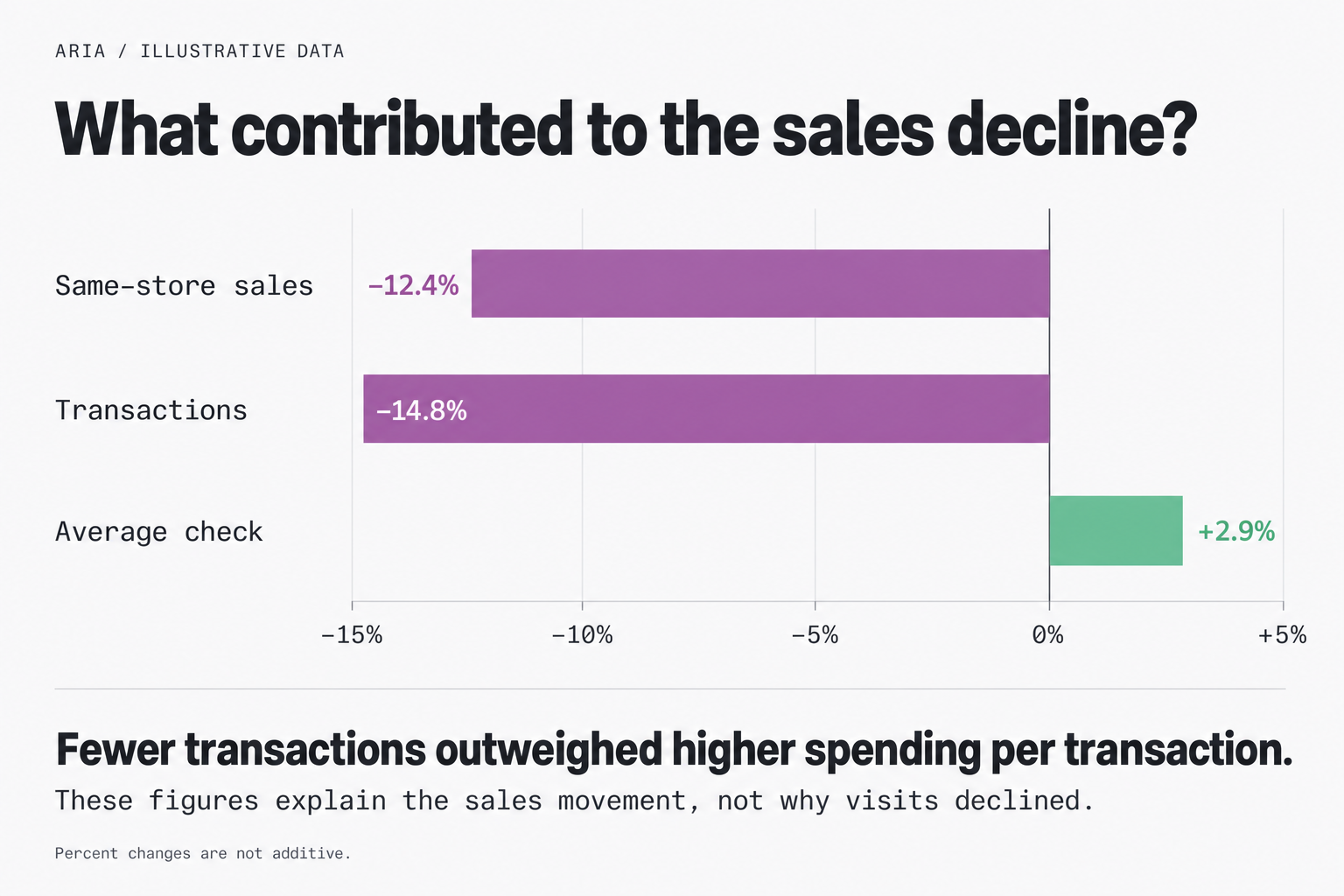
That explains how the measures contributed to the sales decline. It does not yet explain why transactions fell.
This distinction matters when deciding what to do next. If spending per transaction is holding up, the analyst has a reason to investigate the loss of visits more closely. But the available figures alone cannot establish whether that loss reflects changes in customer demand, store operations, competition, or something else.
Those are possibilities to investigate. Treating one as an established cause would go beyond the evidence.
A useful answer moves the investigation forward while making that boundary clear.
An explanation should be open to examination
A plausible answer can sound authoritative even when its evidence is incomplete. For an analyst expected to explain a recommendation to someone else, confidence in the wording is not enough.
The analyst needs to examine the basis for the conclusion:
Which measures support it? A finding about transaction volume should be tied to the transaction figures and their relationship to sales.
Which comparisons provide context? A regional or system benchmark can help establish whether a result is unusual, provided the comparison is meaningful.
What remains unknown? If the next question requires data that is unavailable, the answer should make that limitation clear.
These are practical requirements. They help the analyst decide whether a finding is ready to use, needs another comparison, or requires further investigation.
ARIA’s report-chat experience supports that process by keeping the reported result and the follow-up conversation together. The analyst can question an explanation, explore another comparison, and continue working toward a conclusion they can communicate.
Faster analysis still needs judgment
Speed matters. Analysts face more questions, more data, and more pressure to turn findings into decisions. But an answer delivered quickly is only useful if the person relying on it understands what it supports.
ARIA is designed to shorten the path from a reported result to an explanation an analyst can examine and defend.
The analyst still decides whether a comparison is meaningful. They bring business context, challenge assumptions, and determine when more evidence is needed. Keeping the report and the conversation together helps that investigation move forward.
A report showing declining sales is a starting point. Its value grows when the analyst can explain what contributed, what remains uncertain, and what to investigate next.