
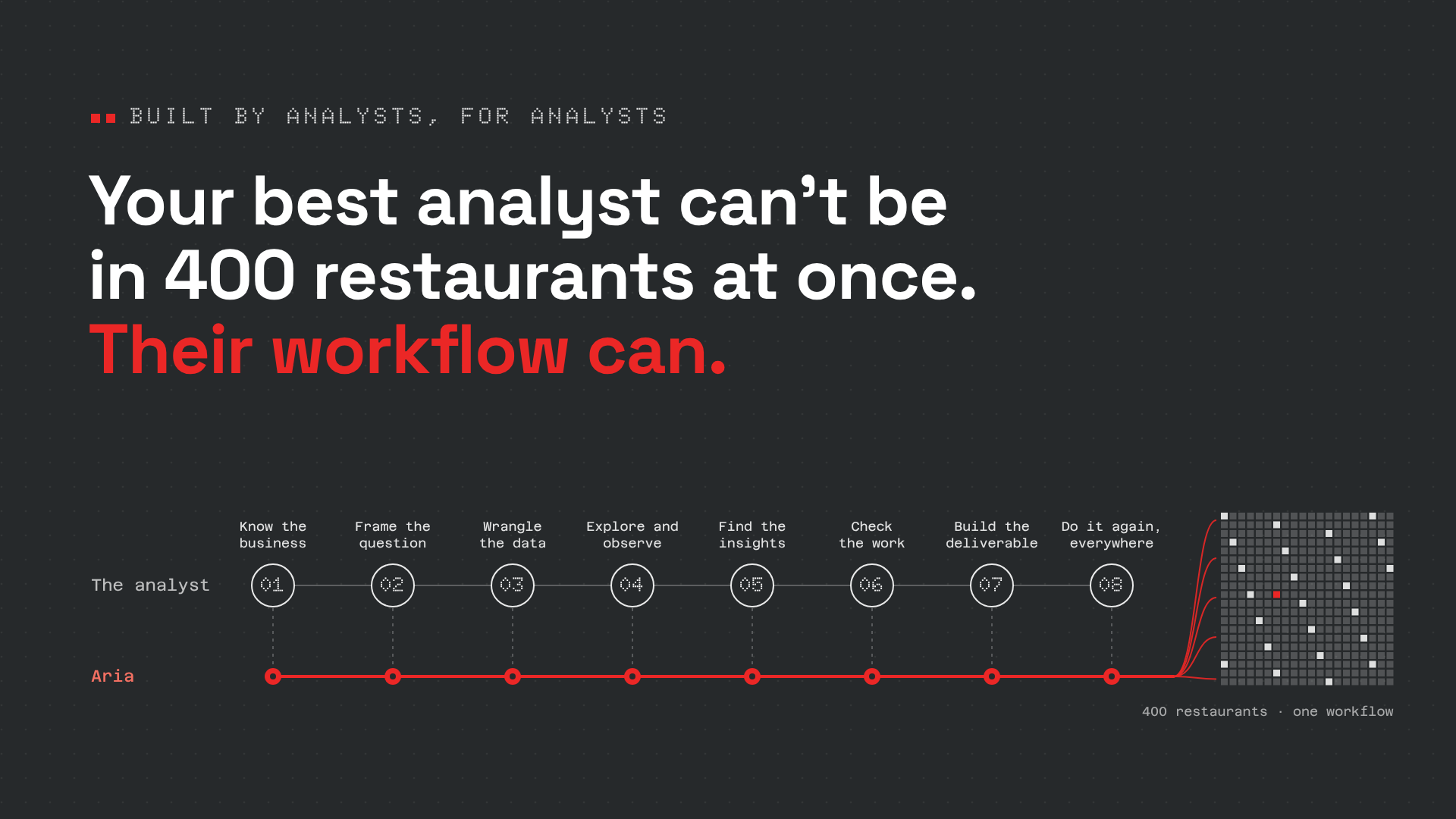
Watch a strong analyst work and you see a method, not magic. Before opening a file, they already know the business: who runs which region, what the last review concluded, which words never reach the CEO.
Then the method runs. They frame the question, pull the data into a spreadsheet and study it until patterns surface. They turn observations into a story, check every number and shape the deliverable for whoever reads it.
That method works. It just doesn't scale: one analyst covers one market this week, and hundreds of restaurants get a dashboard and best wishes.
Aria was built by analysts, for analysts. We took our own workflow apart and built a capability for each step, with the analyst deciding how every step runs. Some steps let AI explore, some hold it to strict rules, and some run plain code with no model call at all.
Below are the eight steps: what the analyst does at each one, and the Aria capability behind it.
01 · Know the Business
What the Analyst Does
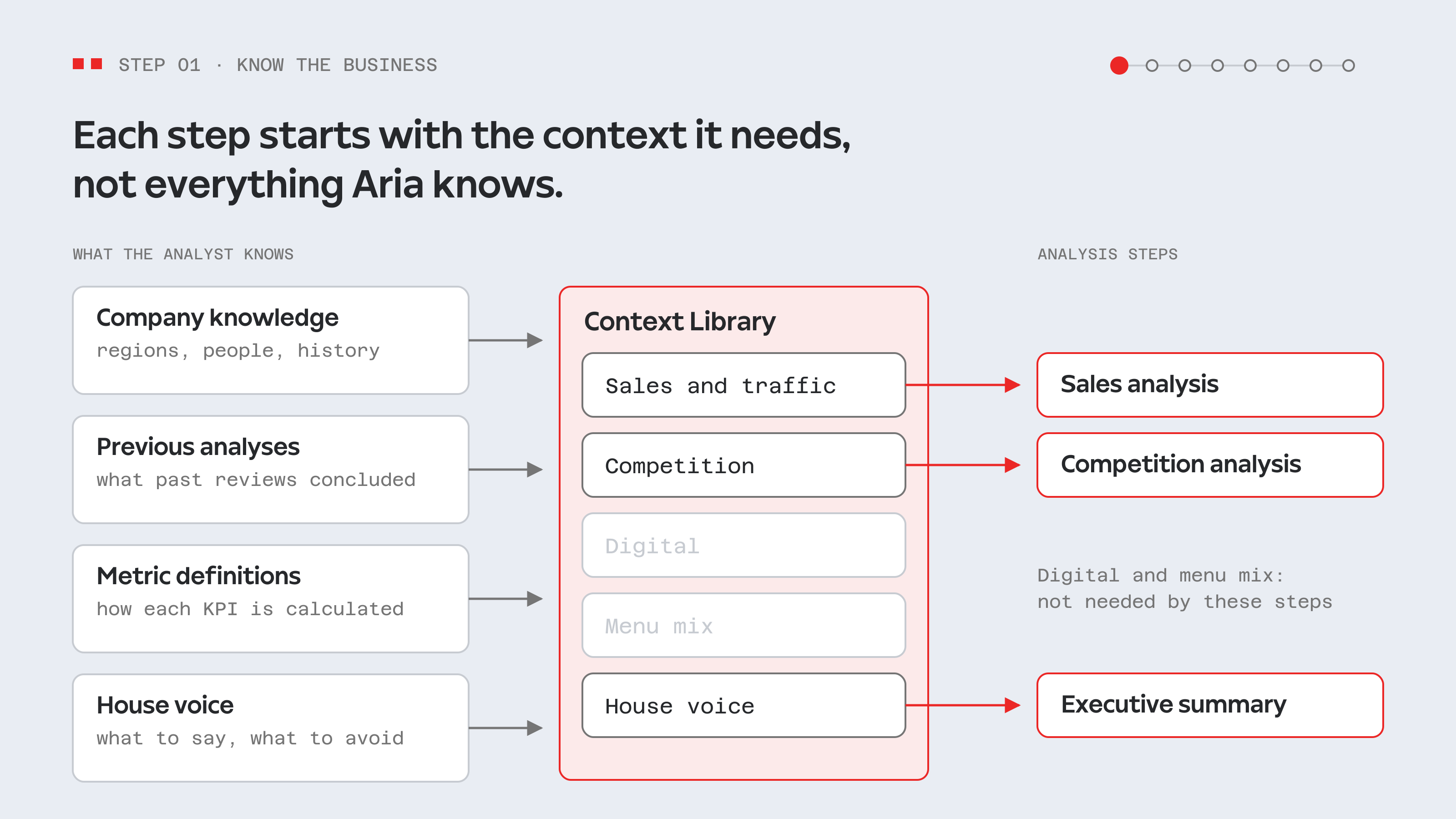
A good analyst never starts cold. They know which regions are under pressure and what the last three reviews concluded. They know how the company defines a comparable sale, and that nobody says "discount" in front of marketing.
What Aria Does
The Context Library holds that knowledge: company context, previous analyses, metric definitions and the house voice. Before the analysis steps run, it is organized by topic, so each step receives a focused slice instead of the whole archive.
Why It Matters
Selection beats volume. A client can hand over gigabytes of material across thousands of files, and pouring all of it into a model doesn't make it smarter, just distracted. So the competition step gets competitive context, and the executive summary gets the house voice.
Where It's Heading
Today the analyst builds and tends the library. Next, it grows from every finished analysis, with the analyst approving what it keeps.
02 · Frame the Question
What the Analyst Does
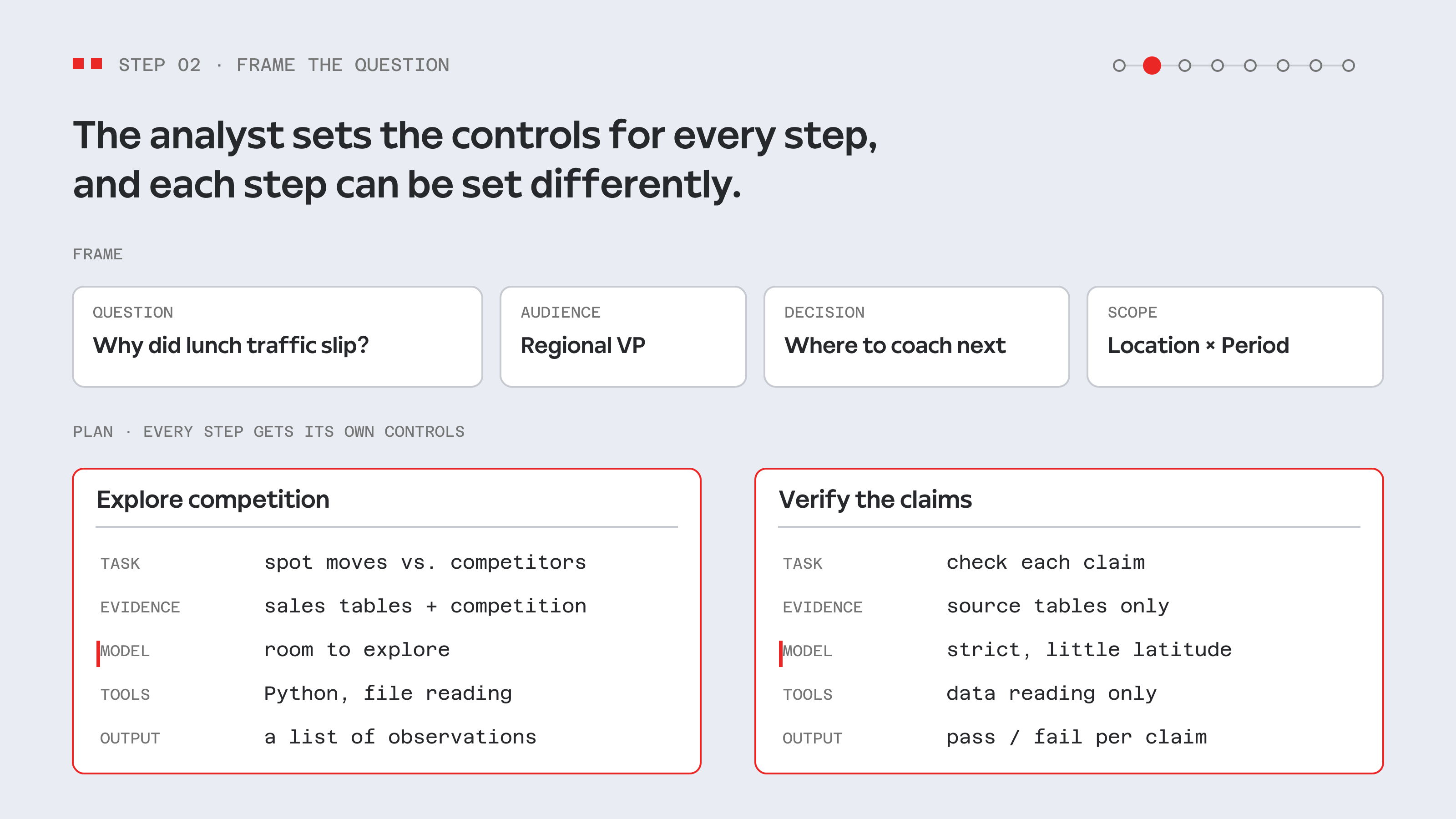
Before pulling a single number, a good analyst settles three things: the question, the reader and the decision it should inform. Then they plan the attack: which pieces of analysis, in what order, and how careful each one must be.
What Aria Does
In Composer, the analyst designs that plan as a workflow of steps. Each step gets its own task and the evidence it may use. It also gets a model, how much latitude that model has, the tools it may call and the output it must produce. Location and period become parameters, so the same plan can later run for any store and any month.
Why It Matters
This is freedom within guardrails. An exploratory step can roam; a verification step stays on a short leash. Some rules are instructions the model follows, and others are checks, such as a preflight review that flags an incomplete setup before a run starts. For reports, we often start from a mockup of the finished deliverable and design the workflow backward from it.
03 · Wrangle the Data
What the Analyst Does
This is the Excel phase: pull the data, join the tables, build the pivots and the views that make patterns visible. It is precise, repetitive work, and nobody wants creativity in a VLOOKUP.
What Aria Does
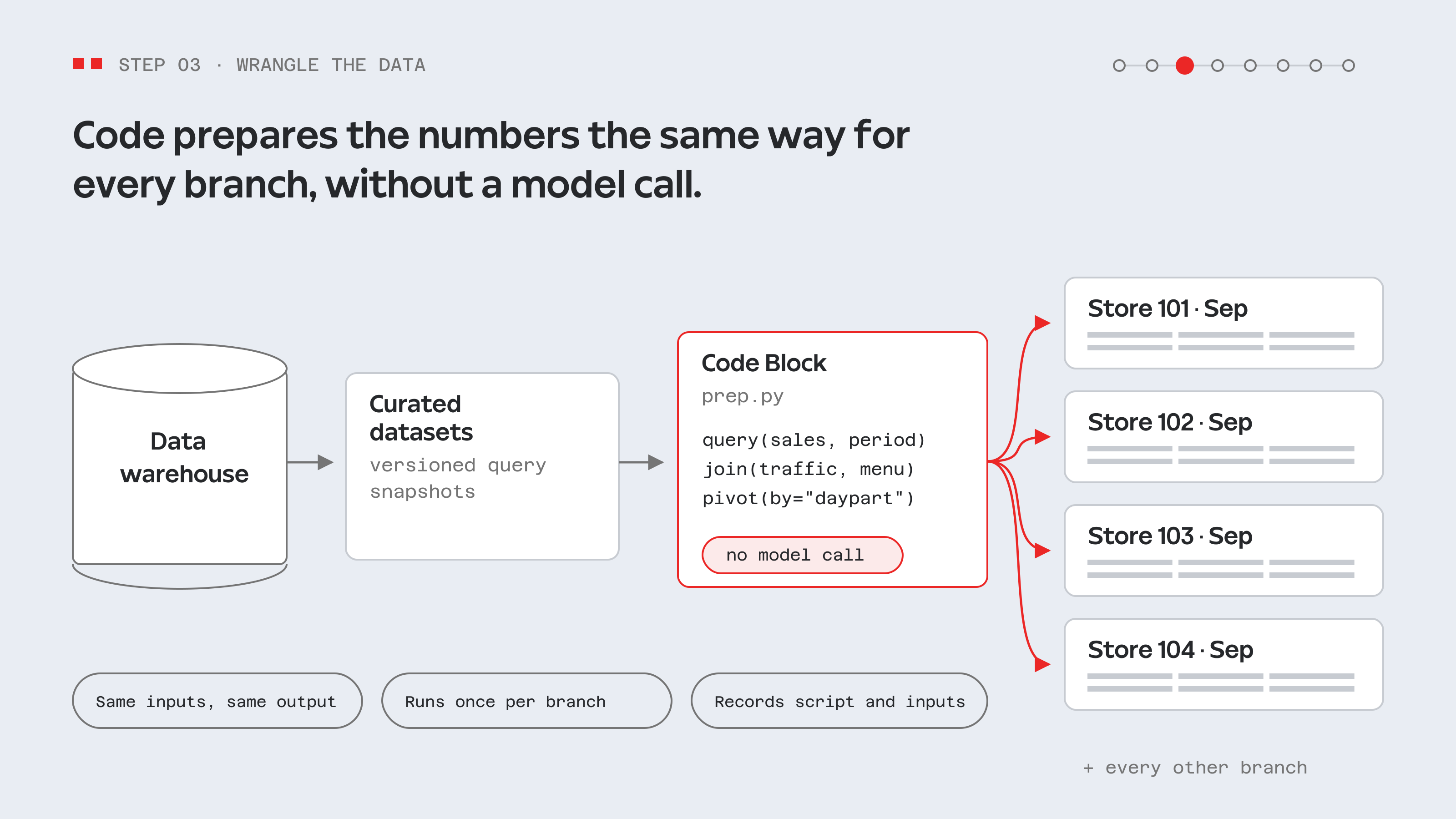
Code Blocks run Python against versioned snapshots of the client's data. They query, join and reshape the numbers into the tables each analysis step needs. No model is involved: the same script on the same inputs gives the same output, for every branch.
Why It Matters
A model is the right place for judgment and the wrong place for arithmetic. Code keeps the numbers repeatable and traceable, because each result records the script and inputs behind it, and no model call is spent on math a spreadsheet does better.
Deterministic isn't infallible, though. A wrong formula is wrong identically in every branch, so the analyst checks the logic once and then reuses it everywhere.
04 · Explore and Observe
What the Analyst Does
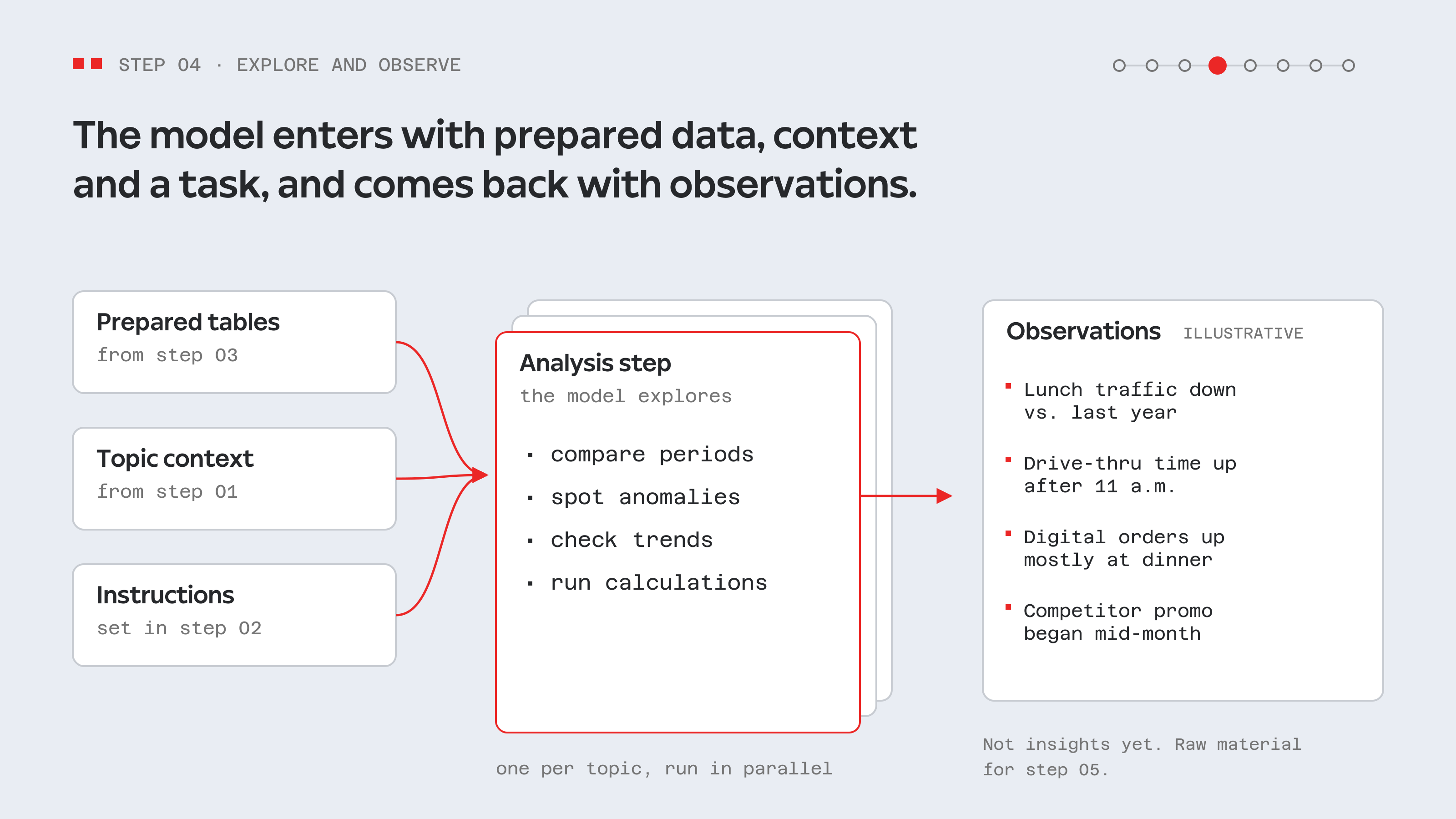
With the views built, the analyst starts looking. Lunch is soft, drive-thru times crept up, digital is growing at dinner. These are observations, not conclusions: notes in the margin that might matter.
What Aria Does
This is the first time a model touches the numbers. Each analysis step receives the prepared tables, its topic context and the analyst's instructions, then explores: comparing periods, spotting anomalies, checking trends and running extra calculations with tools when it needs them. Topic steps can run in parallel, one for sales, one for competition, one for digital.
Why It Matters
Here the model gets room to think, on purpose. It isn't hunting for raw data or doing arithmetic it might fumble, because steps 01 and 03 already handled that. What comes back is a set of observations for the next step to weigh, not a finished answer.
05 · Find the Insights
What the Analyst Does
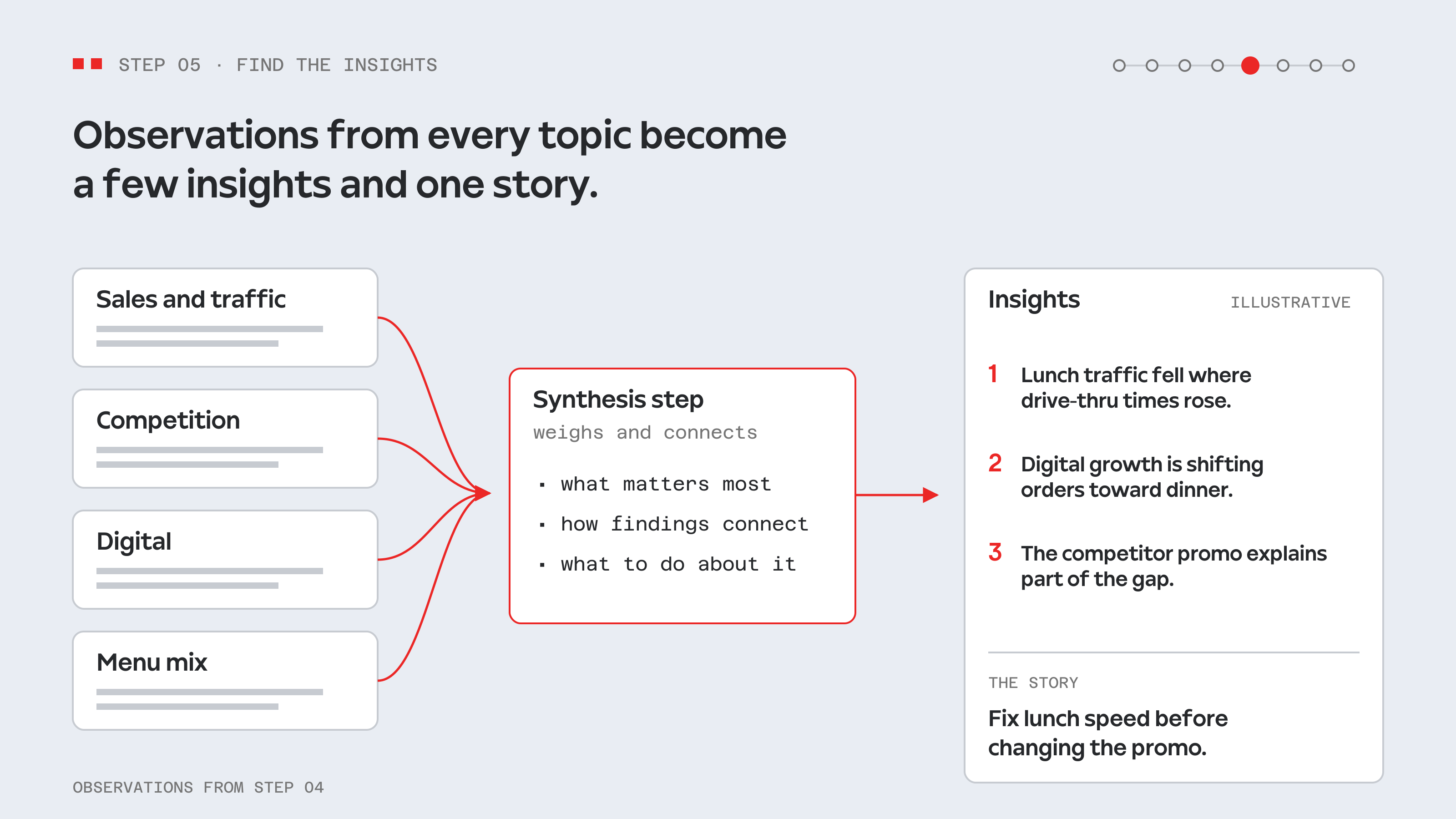
Observations aren't the deliverable. The analyst asks which ones matter, how they connect and what someone should do about them. Slow lunch traffic and slower drive-thru times stop being two notes and become one finding.
What Aria Does
A synthesis step reads the observations from every topic and reconciles them into a few insights and a single storyline. The analyst chooses the shape: topics can run as a chain, so later sections build on earlier ones, or independently, meeting only at the synthesis.
Why It Matters
Insight lives in the connections, and connections need every topic in view at once. Because the observations and the synthesis are saved as separate results, a reviewer can trace each insight back to what fed it.
06 · Check the Work
What the Analyst Does
Before anything goes out, a careful analyst rechecks every number in the story. The one time they skip it is the one time the VP finds the mistake.
What Aria Does
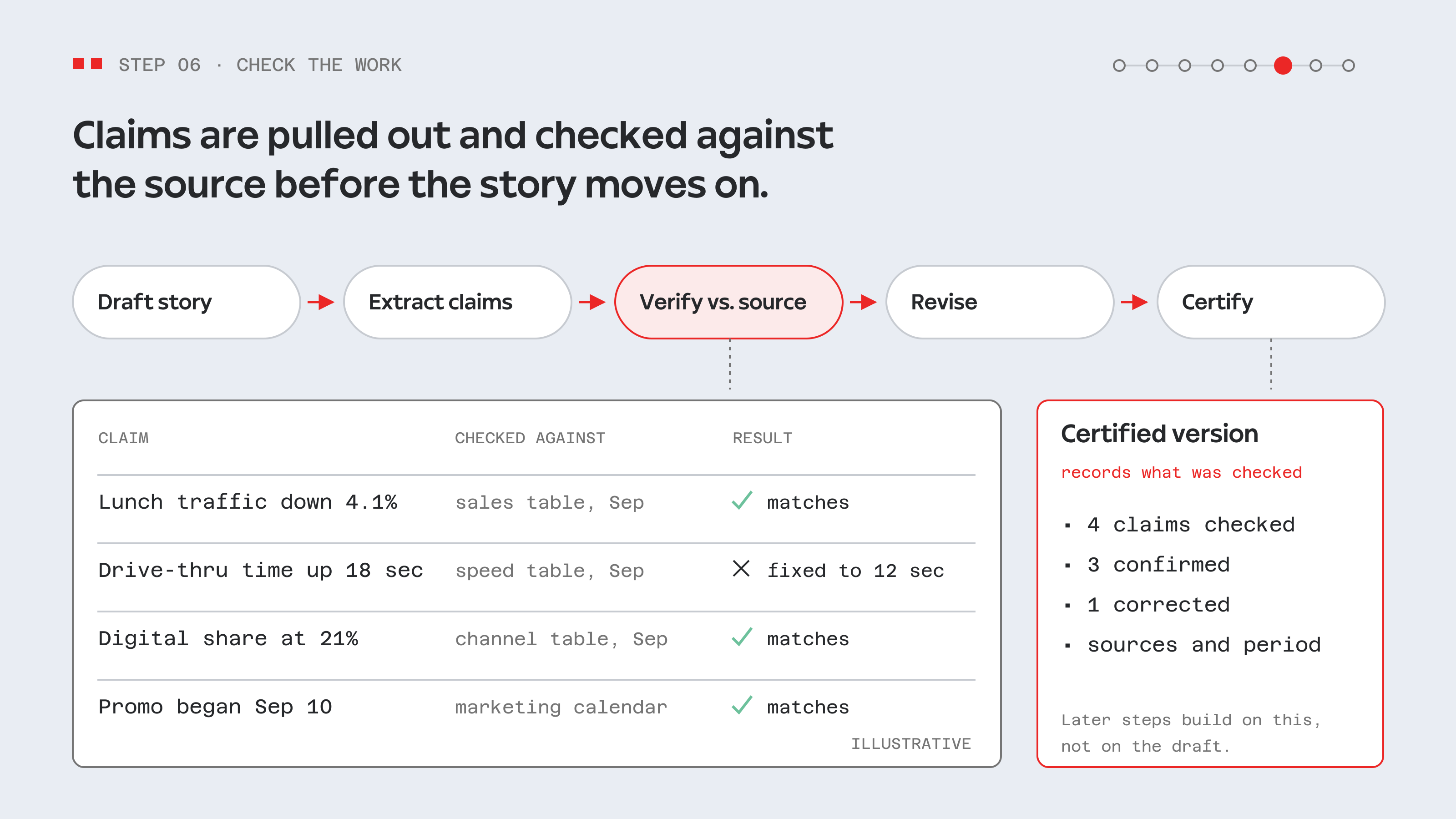
The verification loop turns that habit into steps. One step pulls the concrete claims out of the draft, and another checks each claim against the source data. A revision step fixes what failed, and a certification step records what was checked, against which sources and for which period.
Why It Matters
A citation tells you where a number came from; verification tells you whether the sentence is true. Everything downstream, including the local versions in step 08, builds on the revised version, not the draft.
The analyst designs these checks into the workflow, and Aria can add automatic checks on each step's output, such as confirming a report names the right location and period. They raise the floor. A person still signs off before anything is published.
07 · Build the Deliverable
What the Analyst Does
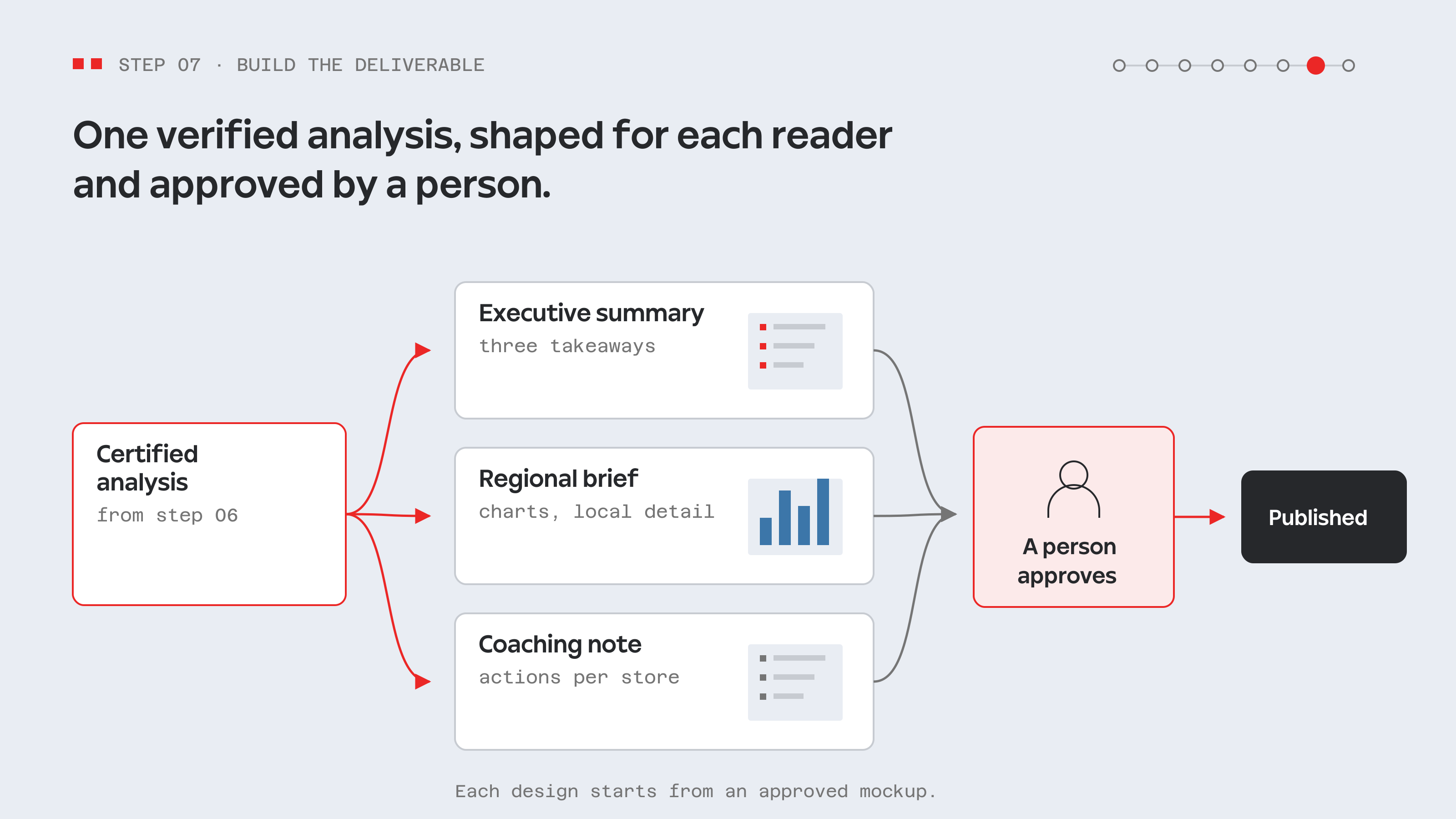
The same findings land differently on different desks. The executive wants three takeaways, the regional director wants the charts, and the store manager wants to know what to do on Monday. Then a manager reviews it before it goes out.
What Aria Does
Report Builder turns the verified analysis into reports designed for each reader. Each design starts from an approved mockup and becomes a versioned template, with instructions written for that audience. Before publication, a review checks the values, charts and layout, and a person makes the approval call.
Why It Matters
Tailoring is designed, not improvised: a coaching note is a different report from an executive summary, not the same one with fewer words. And approval stays human. Aria prepares the report; it doesn't decide when it's ready to ship.
08 · Do It Again, Everywhere
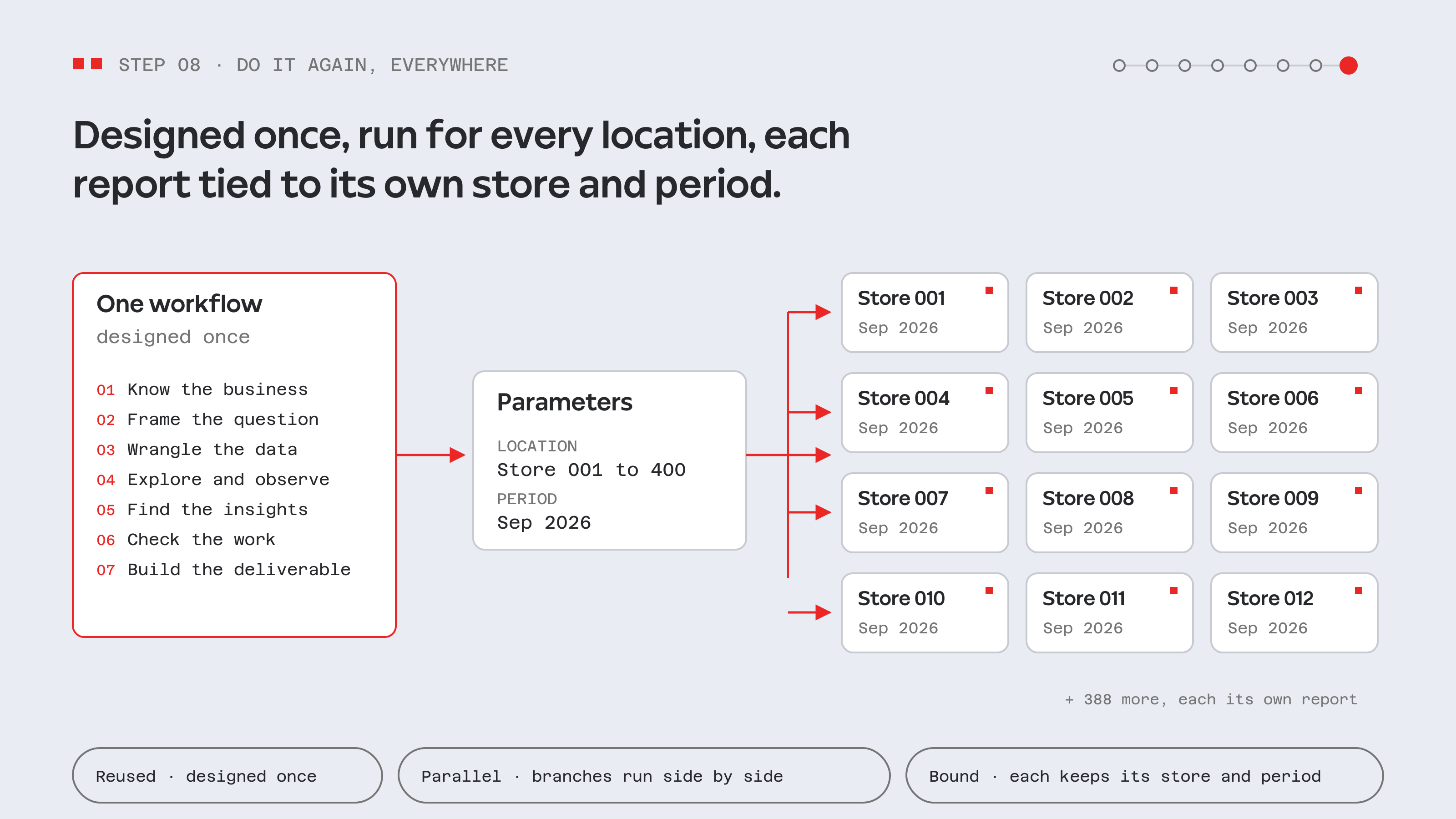
What the Analyst Does
Then the request arrives: great, now do it for every region. And every store. By Friday. This is where the human method breaks, not for lack of skill, but because there's only so much week.
What Aria Does
The workflow from steps 01 to 07 is designed once. Parameters turn location and period into inputs, so one run fans out into a branch per store, and the branches run in parallel within the limits the deployment allows. Each branch carries its own binding, so Store 012's report is built for Store 012 and stays labeled that way.
Why It Matters
Three different things are happening here, and they're worth keeping apart. Reuse means the method is written once. Parallelism means the branches run side by side instead of waiting in a queue. Tailoring, from step 07, means each audience gets a report designed for it. Together they turn one market this week into every store the analyst points it at.
The Analyst Is Still the Analyst
Look back across the eight steps and a pattern shows up. Step 03 runs plain code with no model at all, step 04 gives the model room to explore, and step 06 holds it to strict rules. Knowing which kind of work belongs where is most of the craft.
Aria doesn't replace the person who knows the business, frames the question and signs off on the answer. It takes the method that person already uses and makes it repeatable, checkable and able to run for every store.
In Part 2, I'll share what we learned building it: when to let AI think, when to keep it on a short leash, and when to take it out of the loop entirely.