
A dashboard shows that sales are down. Someone asks the chatbot why. Seconds later there's an explanation, written clearly enough to drop into a business review, and the next conversation is about what to do.
What happened between seeing the decline and accepting the explanation? Which possibilities were investigated? What was ruled out? How did anyone establish that this was the explanation the business should act on?
Dashboards give the business a shared view of performance. They show that sales are down, that drive-through speed is off target, that a region is falling behind. Conversational BI goes further. It makes follow-up questions easy and opens up exploration a fixed dashboard can't anticipate. Both are real improvements. Neither one establishes why something changed, and the fluency of a chat response can hide that the work never happened. An answer that sounds complete can end an investigation before it starts. For a consequential decision, the business needs to know what is true.
What conversational BI does well
Ask which stores account for the decline. Compare lunch with dinner. Separate new customers from returning ones. A manager no longer has to fit every question into views someone designed months earlier.
This is interactive explanation, and for many questions it's enough. A correctly calculated sales total doesn't need a broad investigation. Explaining why performance changed, and deciding what to do about it, does. The interface doesn't tell you whether that work happened.
Where it falls short
The risk comes when a business treats every conversational answer as though it had the depth of an analyst's investigation. Six gaps stand out.
- The user may not know which question matters. A model answers the question it's asked, while a more consequential one goes unexplored. A sales decline might lead someone to ask about pricing when the real issue is customer frequency or service capacity. Knowing where to start is part of the analysis.
- Following the answer takes expertise. Every result creates choices about what to investigate next. An experienced analyst knows when to split a population, challenge a comparison, examine an exception, or abandon an explanation. An easier interface doesn't give every user that judgment.
- Context changes the answer. A promotion, a reporting change, an unusual operating period, or a known source limitation can change the interpretation. If that knowledge lives in someone's head or in one person's chat, two people asking what looks like the same question get materially different answers.
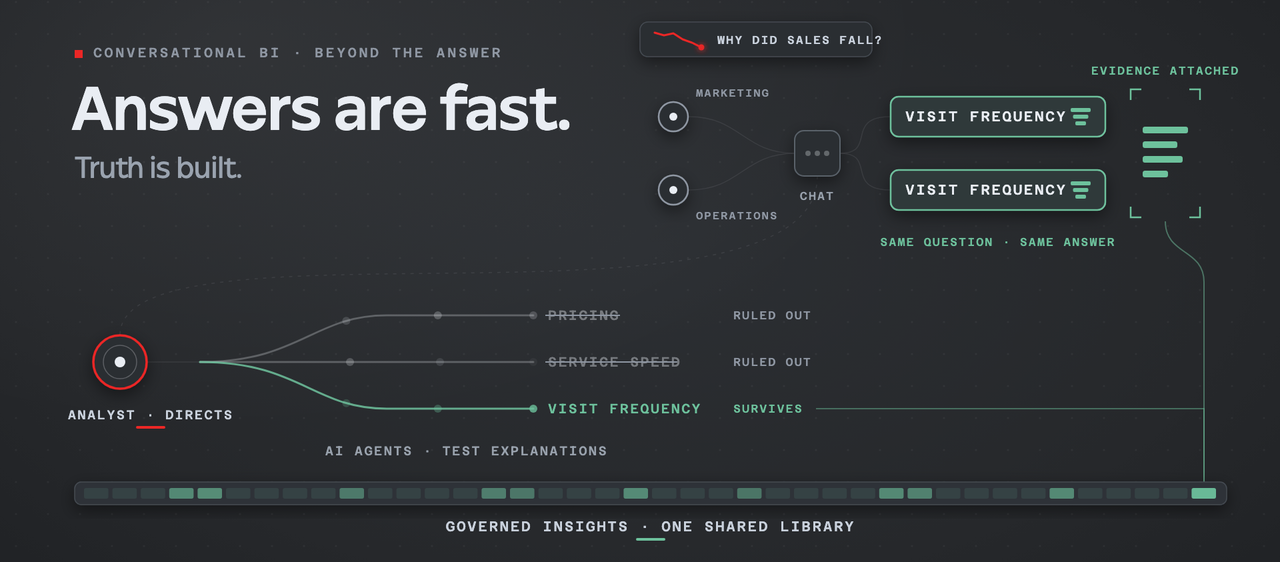
- The same question can produce different conclusions. Retrieving last month's sales should give a consistent result when the data, definitions, and query stay the same. Asking why those sales fell introduces more room for variation. A change in phrasing can send the model down a different analytical path. Even repeating the same question can produce a different interpretation because model outputs can vary between runs. Two people can walk away with different explanations of the same business problem, even though the underlying facts haven't changed. The business needs to know whether a conclusion changed because of new evidence or simply another response.
- The explanation outruns the evidence. A model can find a pattern and describe a plausible reason for it. That doesn't mean competing explanations were tested or that the suggested driver caused the change. Response speed tells us very little about the strength of the conclusion.
- The work stays trapped in individual chats. One person pursues a question, learns something useful, and moves on. The next person starts over. Without retained findings, evidence, and limits, the organization keeps generating interpretations instead of building shared intelligence.
None of these gaps is inherent to a chat interface. A conversation can draw on established analytical work or trigger a deeper investigation. The problem is relying on an answer without knowing which happened.
The consequences are concrete. One team acts on an explanation another team wouldn't accept. A regional review repeats a claim nobody tested. An operational fix addresses the most convincing story while the actual problem continues. The damage comes from the decision made with the answer.
Context is an input, not the analysis
Every Fortune 500 company I've worked with has had data problems. The same revenue figure reported differently by finance and operations. A metric definition that quietly changed partway through the year. A source everyone knew to discount, though nobody had written down why. These were large, profitable businesses, and they thrived despite those issues.
They thrived because experienced people knew how to work around the gaps. They knew which source to trust, where a definition had changed, and which apparent anomaly had an ordinary explanation. That knowledge kept the work moving. It also concentrated a great deal of responsibility in a few people.
AI needs that context made available to it. A semantic layer establishes definitions and relationships, but business context goes further: what happened in the business, which exceptions matter, and what decision the analysis needs to support. It has to stay current and relevant to the question. More context isn't automatically better context.
Context is still only an input. Data, definitions, and context give an investigation what it needs to begin. The analysis is the work of putting them together, testing explanations, resolving contradictions, and determining what the evidence supports.
Consider a hypothetical restaurant group with declining transactions. The data shows slower drive-through service over the same period. A model might conclude that slower service is hurting sales. That's worth investigating. An analyst would still want to know whether the decline is concentrated at those restaurants, whether it began before the slowdown, which dayparts are affected, and what else changed.
Those checks change the action. Staffing support might be the answer, or a different intervention entirely. The initial relationship is a lead. The investigation establishes how much weight the business should put on it.
Grounded in data isn't enough. The conclusion has to survive an investigation.
Build the intelligence behind the conversation
The constraint has always been analyst capacity. Good analysts understand the business, know where the data lives, and can work through its limitations. There aren't enough of them to investigate every question the business should be asking.
Agentic analytics changes that. An analyst directs the investigation: establish the scope, run the comparisons, examine possible drivers, challenge the results, assemble the evidence. Agents take on the execution. The investigation can follow a promising lead, drop it when the evidence fails, and pursue another explanation before presenting a conclusion.
That gives analysts room to investigate questions they previously had to leave unanswered. They can examine more datasets, test more explanations, and follow a finding further before running out of time. The same team can produce a broader body of work across the business. As those findings are reviewed and retained, they become a shared analytical foundation. A question from marketing, operations, or a regional leader can draw on facts that have been checked and explanations that have been tested. Conversational BI becomes a way for the business to explore that growing foundation.
How we built Aria around this
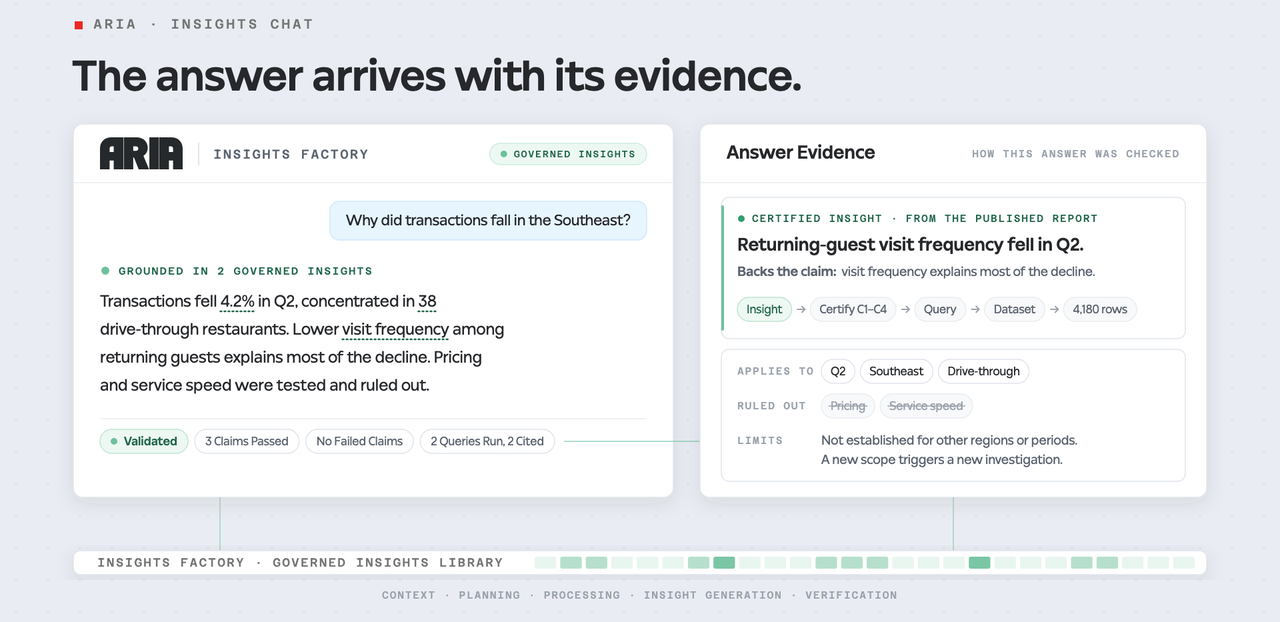
This is the idea behind Aria. Its insights experience, which includes chat, sits on top of a library of governed insights. By governed insights, I mean findings generated through analysis that an analyst has directed, reviewed, and approved. Each finding carries the evidence supporting it, the business conditions it applies to, and the limits of what it establishes.
Does that mean every business question has to wait behind an analyst bottleneck?
No. AI changes how much work can move through it. Agents can run comparisons, pursue explanations, and assemble evidence that previously took substantial manual effort. The opportunity is to increase analytical capacity and speed by 10x to 100x. As the library grows, more business questions can draw on governed insights that are already available.
Aria is built as an insights factory. It brings together business context, analytical planning, data processing, insight generation, and verification to build that library. An investigation connects results across sales, transactions, customer behavior, promotions, and operating conditions. It tests where a pattern holds, where it breaks, and which explanation survives scrutiny. Findings that meet the standard become governed insights. Tentative observations and untested explanations remain distinct from approved findings.
We're building Aria to deliver truth, not just answers. That means establishing what the evidence supports, making the reasoning available to examine, and being clear about what remains unknown. A persuasive response alone can't meet that standard.
Reporting brings governed insights to the business. Chat lets people explore the same library. A regional leader can ask which locations were affected, which explanations were tested, or what supports the recommended response. The response draws on a shared foundation of reviewed findings, with evidence the leader can examine. One governed insight can serve many people and many questions.
New questions can still require new investigation. A finding about one period or group of restaurants doesn't automatically apply to another. When the scope changes or the evidence doesn't establish an answer, the system should make that clear. Further analysis can then expand the library. For consequential decisions, that standard still matters. AI increases how much work can meet it and how quickly that work can reach the business.
See how Aria connects answers to evidence.
Truth the business can act on
Business leaders want to move quickly. So do I. AI should let us investigate more, build governed insights faster, and put them to work across the business. The goal is to make well-supported decisions at a pace we couldn't sustain before.
Dashboards show what's happening. Conversational BI helps us explore it. The insights factory builds the library of governed insights behind those conversations. That gives the business a shared understanding of what's true, with evidence it can examine and act on.