
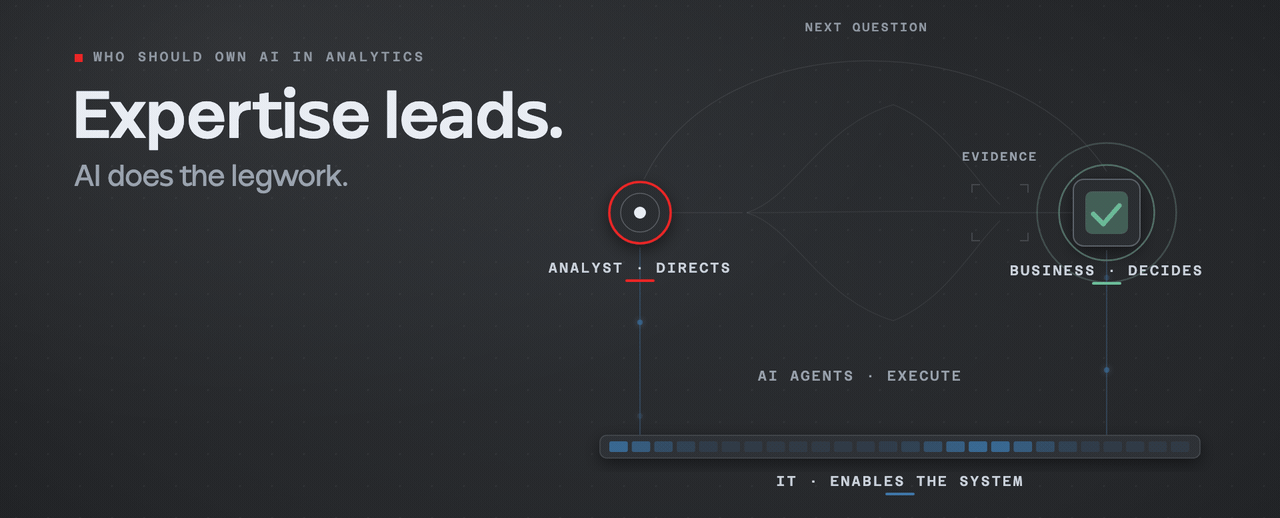
I've spent most of my career inside enterprise analytics teams, first running a services firm and now building AI products for them. The pattern I see most often isn't a data problem. The infrastructure is good. The dashboards are current. And still, when a leader asks why something changed, the answer takes weeks, goes through more handoffs than it should, and often arrives after the decision has already been made.
AI can shorten that cycle and let analysts explore questions they previously had to leave unanswered. Getting that value requires decisions about who directs the work, chooses the tools, and changes how the team operates. My view is that analysts who understand the business should lead the evaluation and adoption, with a decisive voice in tool selection and IT as the partner that makes it work. Get that right and AI helps the business move faster. Get it wrong and the same handoffs remain.
Here is how I think the ownership should split, and why it matters more as AI takes on more of the analysis itself.
Two worlds
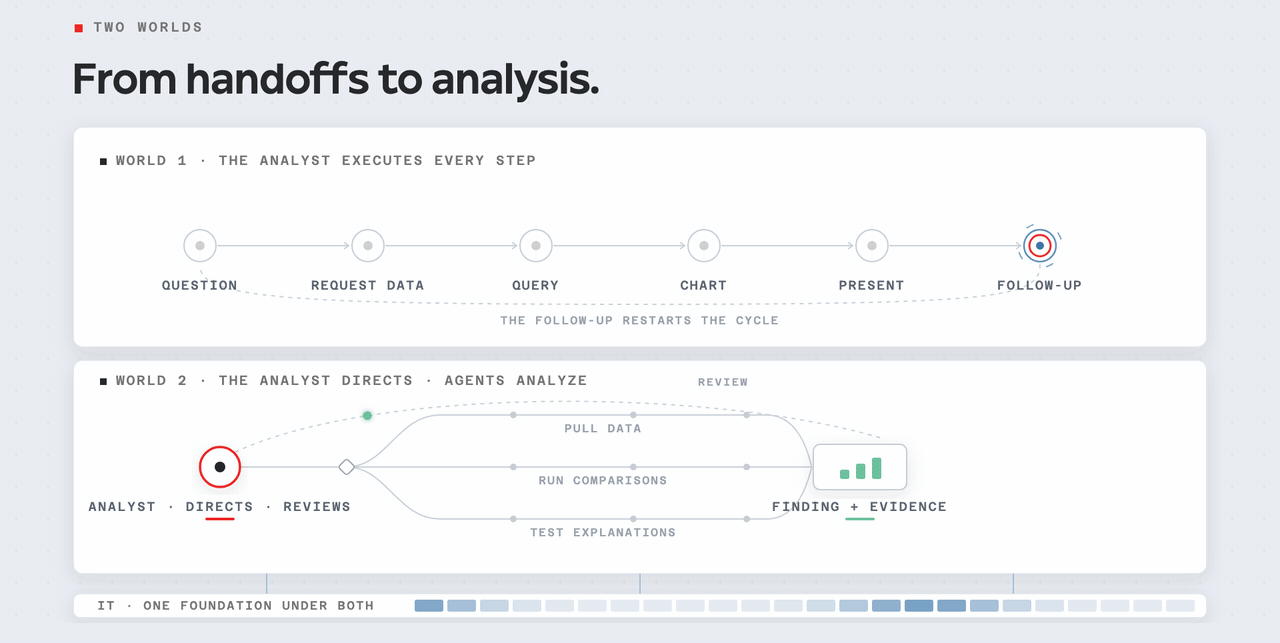
I see two very different ways of working in enterprise analytics right now.
- In the first, the analyst executes every step. Get the question. Request the data. Wait. Write the query. Build the chart. Present. Take the follow-up question back to the desk and start again. A thorough root cause analysis, the kind that explains why something changed, takes weeks and often never finishes. The follow-up question that would have cracked it gets lost in the queue.
- In the second, the analyst uses agentic tools to delegate the analytical work. The agent plans the work, pulls the data, runs the comparisons, tests explanations, and comes back with a finding and the evidence behind it. The analyst's role shifts toward orchestrating the analysis and evaluating the result. I've watched analysts using Aria complete deep dives in hours that previously took weeks. It is a 10x change in how much an analyst can get done, and nobody who has made the switch goes back.
Prevent AI slop
AI slop is fluent, confident nonsense produced at speed. It becomes more likely when the person directing the work lacks business context, or when the tool makes it difficult to inspect and challenge the result. Preventing it requires domain expertise, capable tools, and explicit checks on the evidence.
The analyst who knows the business should direct the work and have a decisive voice in choosing the tool. They understand which questions matter, which explanations deserve scrutiny, and what evidence the business needs before acting. A tool selected mainly for ease of administration can leave those needs unmet.
That is why the ownership model matters more now. The four principles below put the people with domain knowledge in a position to direct the work, with IT providing the foundation and the means to test it.
1. Put AI in the hands of the analysts closest to the decision
When AI can carry out a multi-step analysis, the analysts closest to the business question should be able to direct it themselves. They understand which comparisons matter, what an unexpected result might mean, and which follow-up question could change a decision. That context is what makes the tool useful.
Direct access matters because an analysis evolves as you work. A finding raises a new question. A comparison exposes a gap. An explanation needs to be challenged. Analysts need to follow those threads with the agent while the context is fresh. Routing each new question through another team adds delay and separates the work from the person best placed to steer it.
Give analysts access to capable AI tools and the authority to explore within established enterprise rules. They should be able to start analyses, redirect the agent, and pursue an answer far enough to make it useful. The ownership here is analytical: deciding which questions to explore, how to interpret the evidence, and what the business needs to understand.
Key takeaway: Give analysts direct access to AI and the authority to lead analyses using their business expertise.
2. Partner with IT to enable and accelerate the business
IT and the business share the same goal: get from question to decision faster. IT gets there through the foundation. Pipelines that deliver on time, metric definitions with owners, access controls that reflect real permissions, visibility into failures and cost. Build that well once and every analysis gets easier.
The partnership works when the rules are written together. An analyst working within agreed permissions should know what data and tools are available and be able to start without asking. Reserve review for the genuinely new: sensitive data outside the approved scope, broader access, production changes.
Agentic tools raise the stakes. An agent running a twenty-step analysis depends on the foundation holding at every step. When it does, the business can get an answer the same day. When it doesn't, the agent stalls at step four waiting on access. Track where analysts and agents get blocked and work the list together.
Key takeaway: IT should provide the trusted foundation that lets analysts work independently within clear enterprise rules.
3. Give the business decisive weight in tool selection
Evaluate tools through the work. Can an analyst hand off a deep dive analysis, inspect how the agent got there, push back when the explanation is weak, and refine until the answer holds? You can't learn that from a demo built around single questions with clean answers.
Pick three representative tasks, give every candidate the same data, and let the analysts who will use it grade the results on accuracy, traceability, and effort to reach an acceptable answer. IT brings security, integration, reliability, and cost into the evaluation from day one.
Make the decision rights explicit. Analysts lead the evaluation and recommend the tool. The business sponsor and IT leader resolve the remaining tradeoffs and approve the purchase together. The analysts' assessment of usefulness should carry decisive weight in that decision. A tool that is easy to administer and painful to use is a failed purchase.
Key takeaway: Let analysts lead tool evaluation, with business usefulness carrying decisive weight alongside IT's operating requirements.
4. Let domain experts define context and evaluations
AI needs business context to make sense of the data it uses. That includes how metrics are defined, which business conditions matter, what constraints apply, and what decision the analysis is meant to support. Domain experts know these details and should shape the context that guides the work.
Those same experts should define evaluations (evals): checks that determine whether AI's work meets its intended purpose. Evals should assess whether the numbers are correct, the comparisons are meaningful, the conclusions have supporting evidence, and the analysis addresses the business question. They should also recognize when the evidence is insufficient to reach a conclusion.
IT provides the infrastructure to make that context available and run the evaluations consistently. Together, context and evals make domain expertise reusable across the team's work. Context guides the analysis from the start; evals establish whether the result meets the standard the business requires.
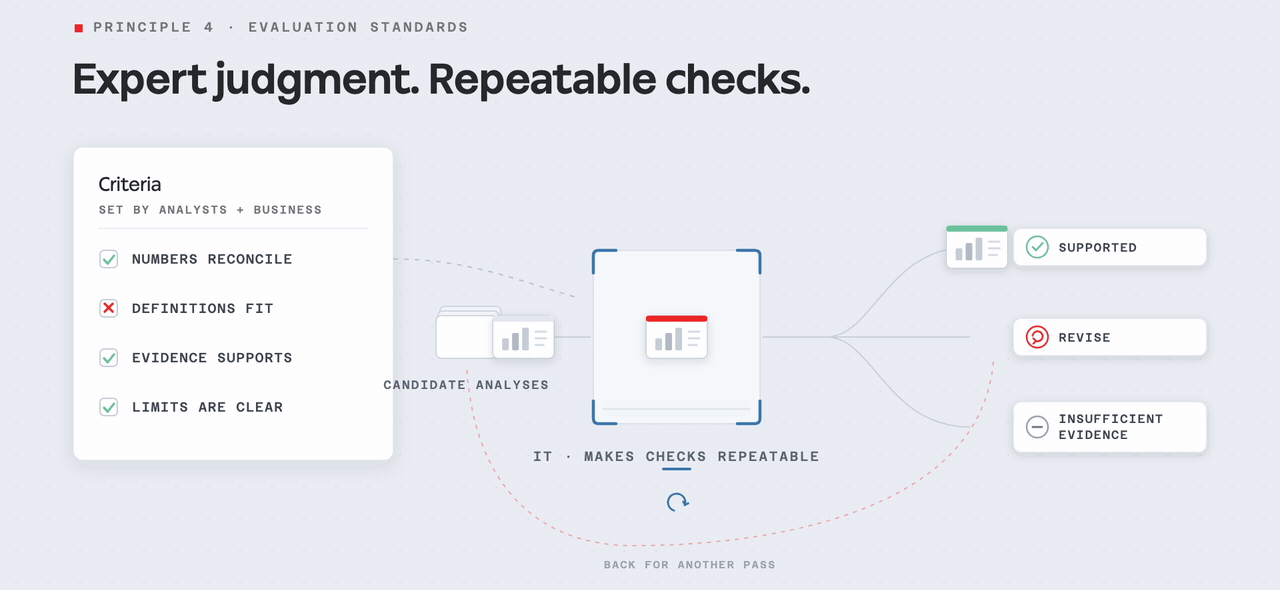
Key takeaway: Domain experts should define the business context that guides AI and the evaluation criteria used to judge its work.
Five misconceptions that slow this down
- Owning the platform means owning the use cases. Platform ownership and analytical leadership require different expertise. IT owns the environment and enables the business to act on its questions. Analysts lead the exploration. Business owners are accountable for the decision.
- Better models reduce the need for domain expertise. More capable agents still need a worthwhile question, the right context, and someone who can tell when the answer is wrong. As agents take on more execution, expert direction and evaluation become more consequential.
- Business autonomy weakens governance. Clear permissions and observable activity make greater autonomy workable. Well-designed governance lets people proceed within agreed rules and brings new risks forward for review.
- Tool selection is a technical decision. Users know the work and the standard the answer has to meet. IT knows the requirements and cost of operating the tool. Both forms of expertise need meaningful authority in the choice.
- The model can judge its own output. Confidence isn't evidence. Experts define correct and useful. IT makes the test repeatable. Models can help apply those standards, but their judgment alone isn't proof that an answer is sound.
AI gives analysts more capacity to pursue the questions that matter. Realizing that value means giving them direct access, a decisive voice in the tools they use, and clear standards for judging the results. IT provides the trusted foundation that makes that autonomy possible. Business leaders remain accountable for acting on the evidence. Each group has a clear responsibility, and the analyst has the room to do the work.