
If your analysts are just now becoming 10x, you're already behind the companies setting the pace in analytics.
Most enterprises are just beginning. They're putting coding agents in analysts' hands, and the analysts who use them well are moving much faster. That's real progress. It's also only the first step.
The point of all of it is insights: what's happening in the business, what changed, why it might be changing and what deserves action. Reports, charts and dashboards are how those insights get communicated, and they matter, but producing them was never the whole job. The job is asking good questions and investigating them well.
Agents help most there, as long as people who know the business are guiding them. Domain experts know which comparisons mean something, what context changes the read and what a good answer has to hold up against.
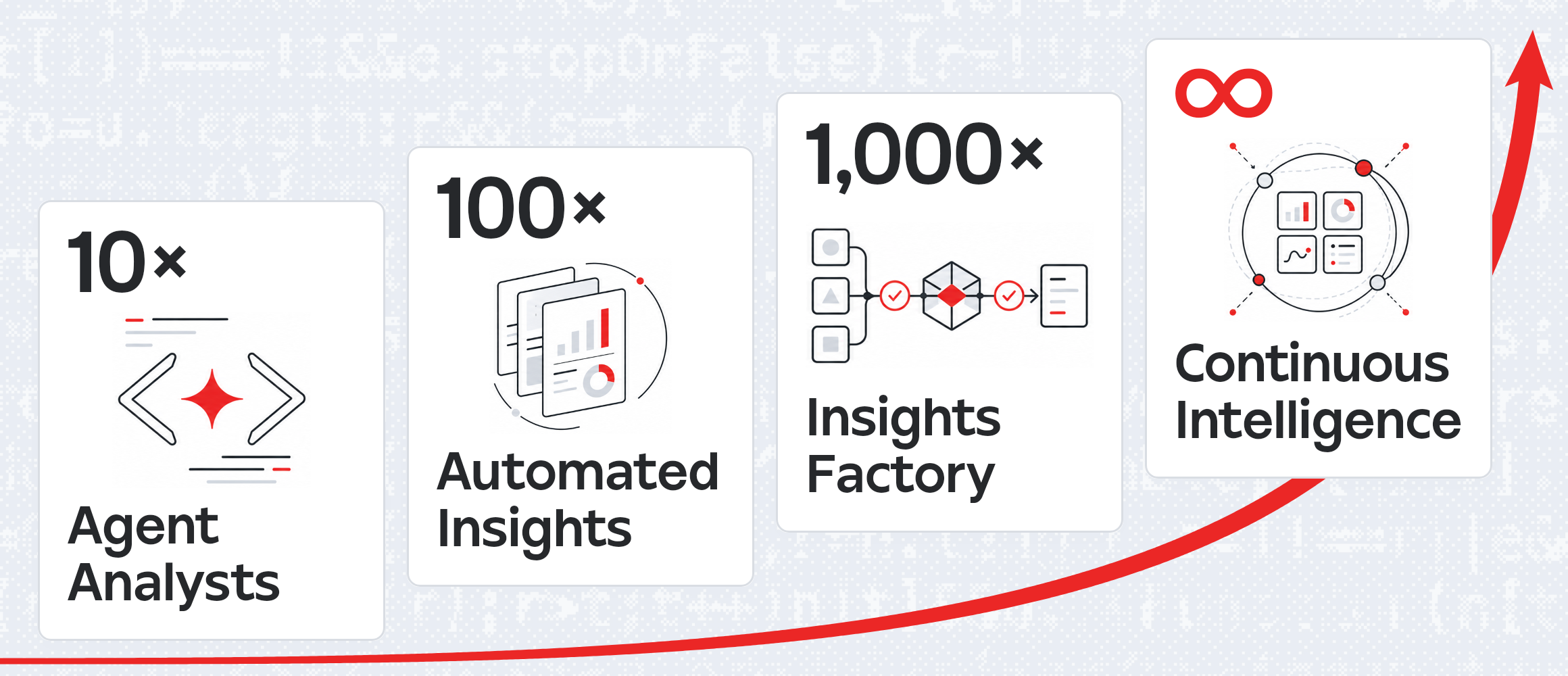
I think about the path from agent-assisted analysis to continuous business intelligence in four stages:
- 10x Agent Analysts
- 100x Automated Insights
- 1,000x Insights Factory
- ∞ Continuous Intelligence
The multipliers describe how far one expert's judgment can reach. At every stage, the analyst investigates, writes methods, reviews findings and directs the work. Each stage shifts their time one step further down that list.
10x Agent Analysts
The 10x analyst is the starting line.
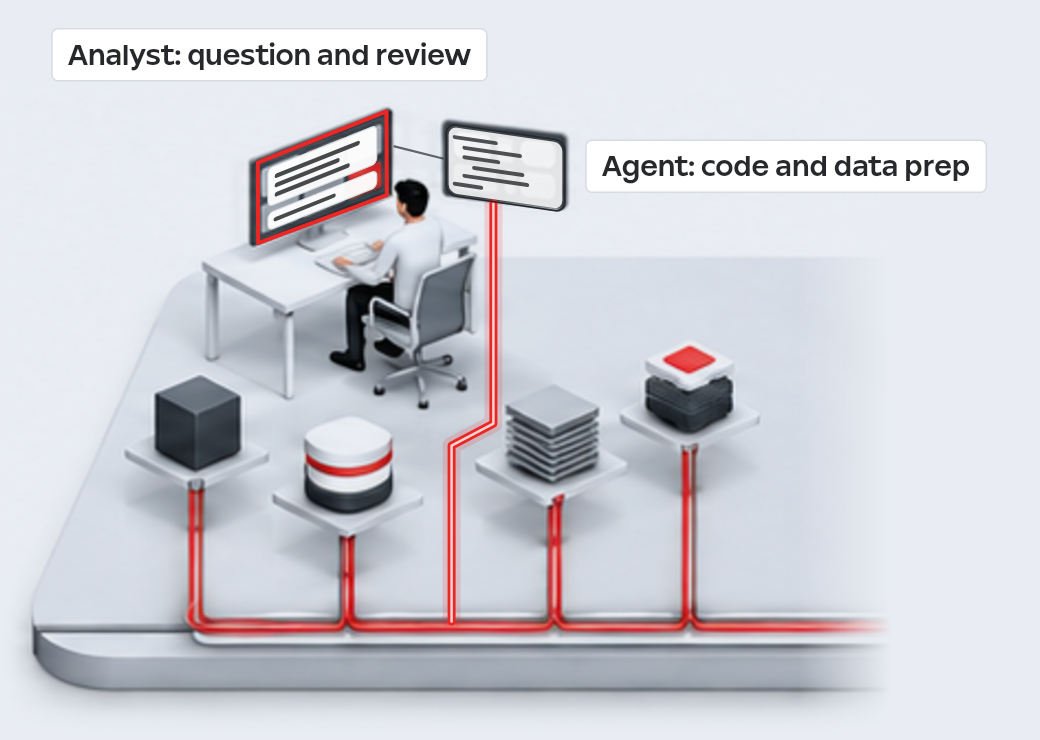
The analyst's time goes to investigating. Agents handle the data prep and syntax, and the analyst owns the questions and the conclusions. An analyst works with a coding agent like Claude Code or Codex, which can read the files in a project, edit code and run commands.
The analyst sets that project up with approved access to the data, the team's definitions written down and the context from earlier work saved alongside. That way the agent knows what counts as a comparable store and which tables are the source of truth.
Then the analyst brings a question. Say sales in one region slipped last month. The agent writes and runs the SQL and Python, reconciles the totals against the system of record and cuts the data by store, product and day.
Was it fewer transactions or smaller checks? The agent lays out the evidence for each explanation, and the analyst decides which ones hold up and which are just two lines that happened to move together.
The same help carries into the BI work where findings get communicated. An agent can help build the data model behind a dashboard, write and debug a DAX measure in Power BI or a calculated field in Tableau, iterate on a chart until it makes the point, or dig into why a dashboard shows something odd.
An analyst can run several agents at once and share the project with the team, so each investigation starts from what everyone already learned. Aria brings the same kind of agent help to analysts working inside their governed data.
The analyst spends less time on data prep and syntax and more on framing questions, challenging the agent's logic and owning the conclusion. That's what organizations should reward.
IT's role is enablement: trusted access, solid infrastructure and reusable standards that let domain experts move quickly. It's the split I argued for in Who Should Own AI in Analytics, where domain experts define the context and evaluations and IT partners to accelerate the business.
100x Automated Insights
Stop rebuilding the same report.
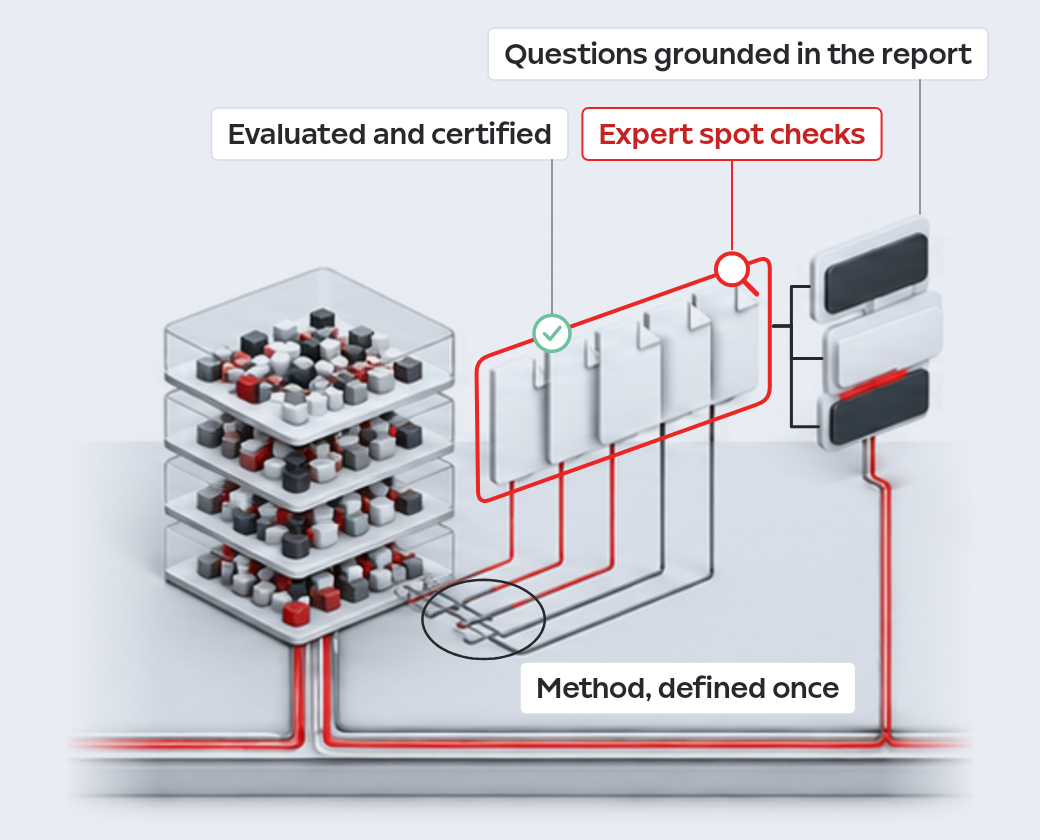
The analyst's time goes to writing methods: how a sound investigation of a recurring question works, like how the week went, which locations moved and why, so agents can repeat it and fan it out. The domain expert who wrote it stays responsible for keeping that analysis and its checks useful.
In Aria, that write-up lives in Aria Composer: the comparisons, inputs, calculations, checks and what a finding can and can't claim. Aria reuses the method so the question gets the same careful treatment every time.
It also fans the method out into parallel investigations scoped by region, store, product line or customer segment, each with its own data and context.
That fan-out is what turns automation into more insights instead of more copies of a report. Picture a chain with 400 stores. The regional view shows sales flat, while a dozen stores underneath are struggling and a dozen more are having a great month.
With the method fanned out, each store gets its own look at what changed and what might explain it, and attention goes where the evidence points.
Data verification has to scale
Nobody can read 400 investigations a week, so data verification has to scale too. That's what evals are for. Every output goes through Aria's evaluations, which pull out the claims, verify them against the data and flag what doesn't hold up. Findings that pass are certified and become governed insights the business can trust.
Domain experts set the standards those evals enforce. Then they review the results, investigate the exceptions, run deterministic checks like reconciling totals and spot-check samples. A passing check isn't a guarantee. Practical oversight of the system producing the findings is what keeps them trustworthy.
The analyst also pulls the pieces together. Fourteen stores softening in one region in the same week deserves a different next question than fourteen unrelated bad weeks. Certified findings go into the insights library, where reports draw on them and chat cites them when someone asks a follow-up.
Analysts who thrive in Automated Insights can write down how they analyze a business question clearly enough for agents to follow, and recognize when the analysis goes wrong.
1,000x Insights Factory
Every team asks. The factory keeps up.
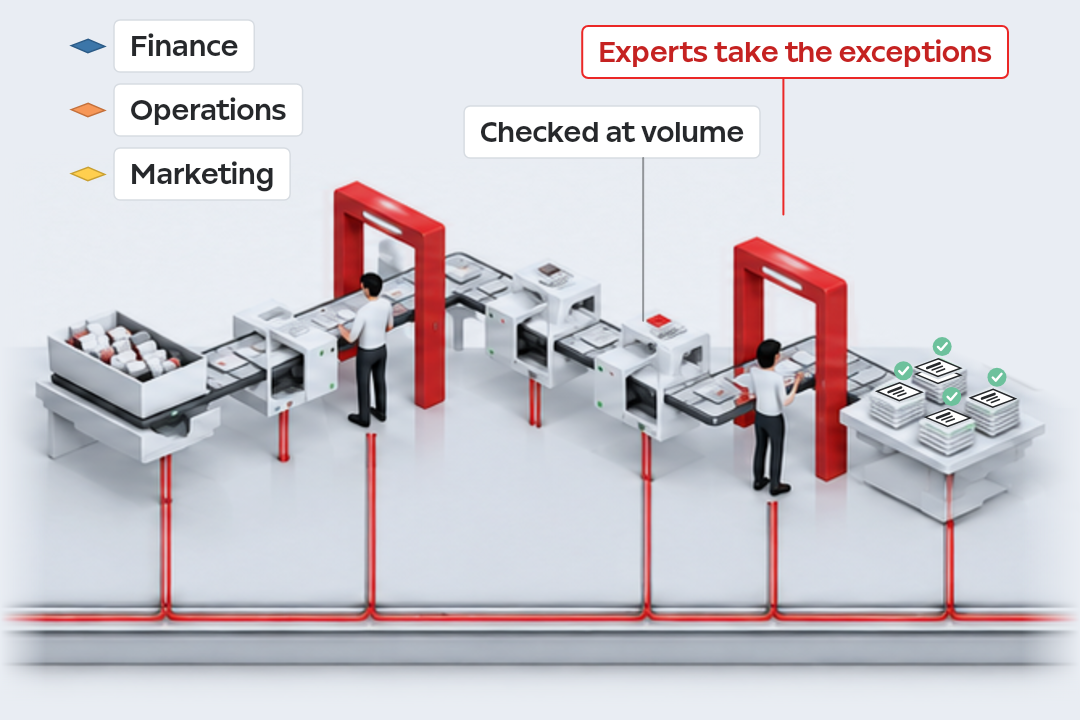
The analyst's time goes to reviewing findings. Agents take requests from every team and do the work end to end, so the questions that used to sit in a backlog get answered.
Questions from every team
Most of a company's demand is new questions from every team. The factory takes that on without leaving a small group of analysts to answer everything by hand.
Intake can follow how the business is organized. Finance, operations and marketing might each run their own queue in a system like Jira or Linear, with their own experts deciding what's worth the work. That specialization is an asset. What the teams share is the production underneath.
Agents take each request through intake, scope it, pull and prep the data, pick a method from Aria Composer and run the investigation, fanning out wherever a question needs it.
By the time a request reaches a person, the work is mostly done and what's left is review.
The questions field consultants bring
Picture a fast-casual franchise brand with a dozen field consultants. Each has their own deep-dive questions.
- One needs a turnaround case for a struggling franchisee: two years of sales broken into traffic, check and mix by daypart, compared against matched peer stores, tied to staffing and guest feedback, and sized against what recovering to the peer median would be worth.
- Another wants to know whether last year's remodels paid off once seasonality and new competitors nearby are accounted for.
- A third wants to know whether a local price test should roll out across her territory, and what it did to traffic and to the rest of the menu.
Today each of those is a multi-week analyst project, so most consultants never get one.
In the factory, all of those questions move through intake, prep and investigation at the same time. Each one lands for expert review with the evidence assembled and the claims already checked, so a small team of experts can review dozens of investigations a week instead of building a handful. Marketing and operations run through the same production, the same checks and the same library.
Controls follow the risk
Oversight works the way it does in Automated Insights, at a larger scale. Automated evals and certification handle the volume, while experts watch the results, take the exceptions and sample the rest.
Controls follow the work and the risk. A number headed to the board deserves more scrutiny than a quick operational read, and the experts in each domain are the right people to decide how much.
This is where analytics becomes an org design decision. A command center shows what's queued, running, flagged and delivered across every intake.
An insights factory lets a small analytics team review more requests because agents prepare the data, run the analysis, and assemble the evidence.
Every certified finding joins the insights library, so each answered question makes the next one faster.
∞ Continuous Intelligence
Every finding grounds the next answer.
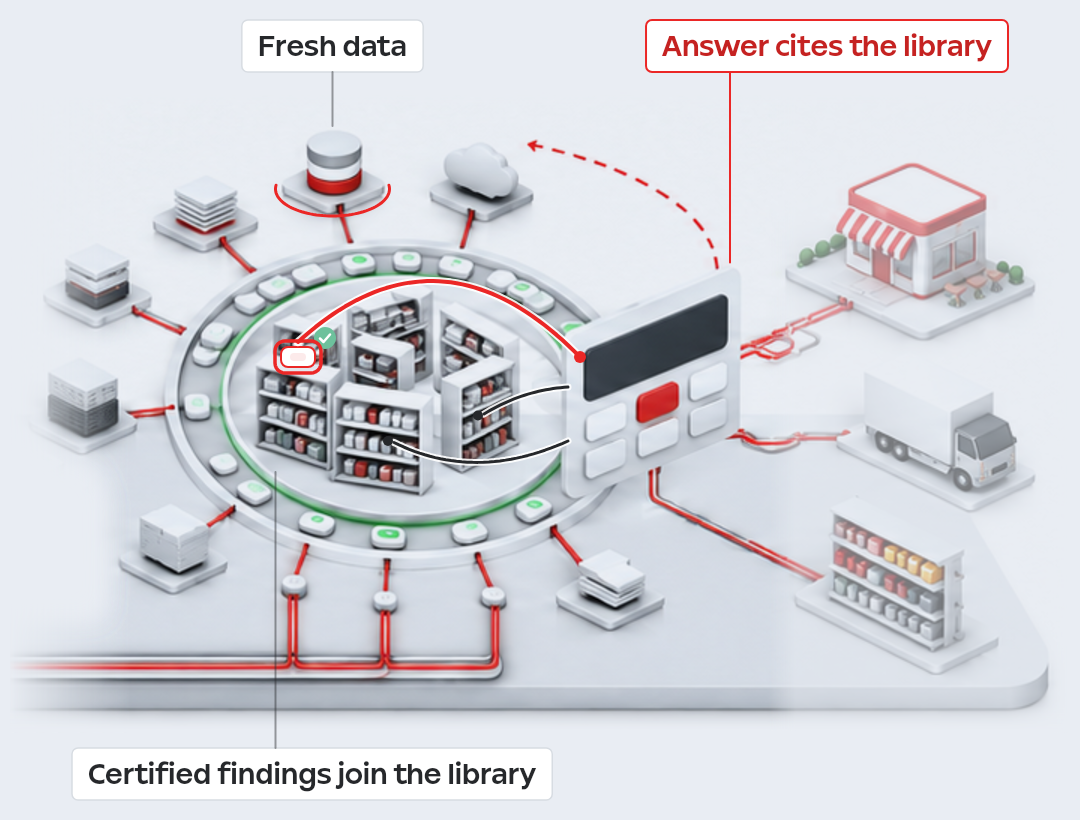
The analyst's time goes to directing the work: what the platform watches, how far it can go and what it should stop trusting.
The intelligence is deep enough, wide enough and automated enough that people get answers when they need them. Sometimes that's just in time: the platform recognizes the moment an insight matters and delivers it to the people who own the decision, before anyone thinks to ask.
Picture drive-thru times creeping up across 30 stores in two regions. Nobody has filed a request. The platform notices the shift, runs the investigation, ties it to a scheduling change that cut a position during the lunch peak and sizes what it's costing in lost transactions. The operations director has the finding Monday morning, before the weekly call.
Other times it's in conversation. A regional leader asks Aria why something moved, or a layered question that used to take an analyst a week, and gets an in-depth answer grounded in certified findings, many from investigations nobody had to request.
The analyst's role
The analyst's role changes with it.
Analysts become mission commanders.
They set the platform up, give it the right domain expertise and analytical frameworks, and make sure what it delivers holds up.
That command takes real judgment. Unlimited curiosity sounds great until it shows up on the compute bill, and a finding about last quarter doesn't automatically hold this quarter, so someone has to retire what's gone stale. Those calls are where analysts spend their time.
Where to start
The gap between most enterprises and the frontier is organizational, and it compounds. Every month an insights factory runs, its methods get sharper, its evals get better and its library of certified findings gets deeper. Each of those improves the next month's work, so the distance keeps growing.
Closing it starts with two things you can do now.
- Give analysts room to learn agents and apply them to their own work.
- Have your domain experts document how your analytical frameworks should work, so agents can apply them across the business and people can evaluate the results.
The organizations doing that work now are building the knowledge their future answers will stand on.